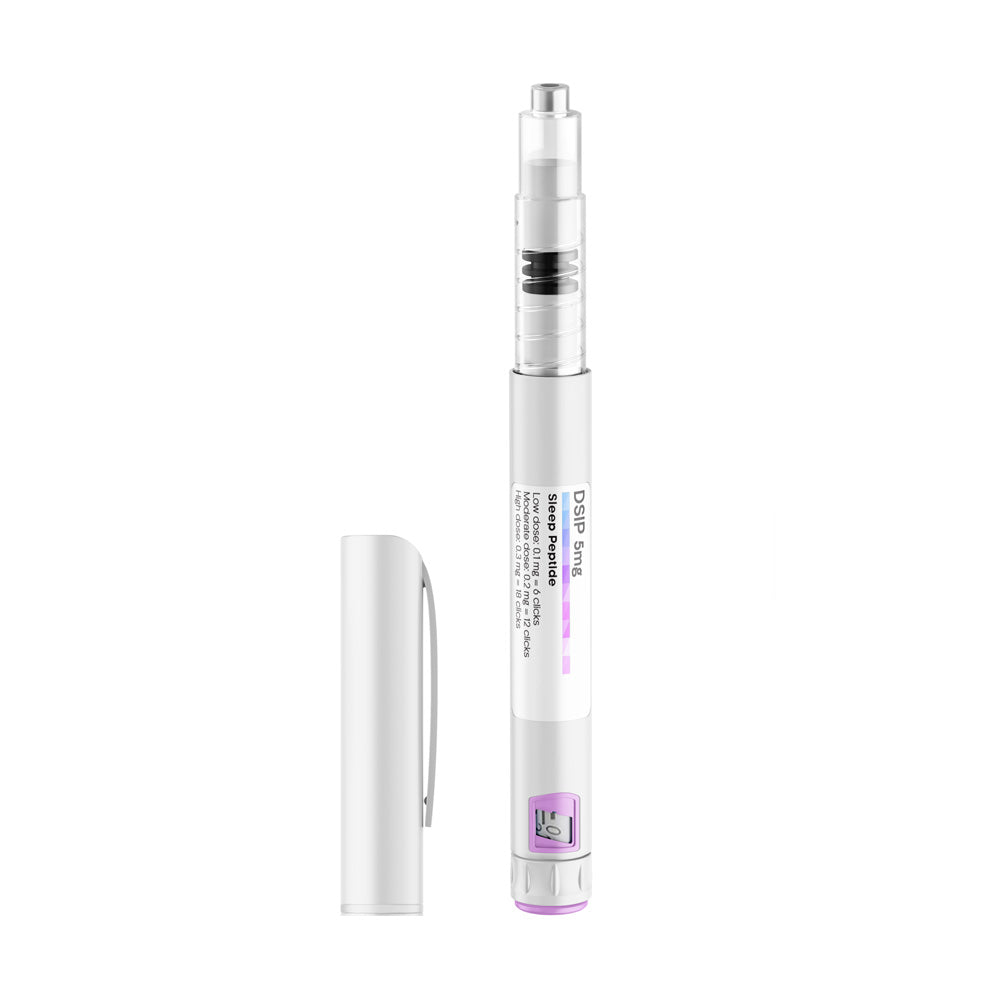
DSIP Peptide
DSIP Peptide
DSIP (Delta Sleep-Inducing Peptide) is a neuropeptide designed to support deep restorative sleep by helping regulate sleep architecture and reduce nighttime awakenings. It is commonly used in recovery and stress-modulation protocols to promote improved sleep quality, nocturnal growth hormone release, and next-day mental clarity.
Couldn't load pickup availability
Share

What is DSIP?
Delta Sleep-Inducing Peptide (DSIP) is a naturally occurring nonapeptide — a short chain of nine amino acids — first identified in the 1970s in cerebral blood and brain tissue. It earned its name because of its early observed ability to enhance delta wave activity, the hallmark of deep, restorative sleep, in animal models and preliminary human studies.
How does DSIP work?
Unlike conventional sleep medications that act like sedatives, DSIP appears to modulate key neurochemical and hormonal systems involved in sleep architecture and stress responses. Laboratory and clinical research suggests it interacts with central neurotransmitter networks — including GABAergic modulation — to influence deep sleep timing, and may affect circadian regulation and stress hormone cascades without inducing classic pharmacologic sedation.
What makes DSIP unique?
What makes DSIP unique is this regulatory rather than sedative profile: rather than forcing sleep, it seems to support natural sleep processes and neuronal balance. Early human studies reported increased sleep pressure and improved sleep efficiency without typical sedative side effects, and multiple animal studies report effects on stress adaptation, neuroprotection, and bioenergetics.
Key benefits:
• Promotes Deep (Delta) Sleep - Research in humans has shown DSIP can increase total sleep time and boost deep sleep stages, supporting restorative sleep cycles.
• Supports Sleep Architecture - Findings from animal models show DSIP reduces sleep latency and increases slow-wave sleep without disrupting REM sleep patterns.
• Modulates Stress & HPA Axis - Preclinical evidence suggests DSIP influences stress-related pathways, including hormonal signaling involved in the hypothalamic-pituitary-adrenal (HPA) axis, potentially mitigating stress responses and cortisol production.
• Neuroprotective & Antioxidant Effects - Animal studies show DSIP enhances mitochondrial respiratory efficiency and may offer protective effects under oxidative stress conditions.
• Anticonvulsant Activity (Preclinical) - Experimental research demonstrated DSIP reduced seizure incidence and duration in reflex epilepsy models, indicating neuromodulatory potential beyond sleep.
• Pain & Mood Modulation (Pilot Human Data) - A small clinical pilot study in patients with chronic pronounced pain reported significant reductions in pain and depressive symptoms following DSIP administration.
What is DSIP?
Delta Sleep-Inducing Peptide (DSIP) is a naturally occurring nonapeptide — a short chain of nine amino acids — first identified in the 1970s in cerebral blood and brain tissue. It earned its name because of its early observed ability to enhance delta wave activity, the hallmark of deep, restorative sleep, in animal models and preliminary human studies.
How does DSIP work?
Unlike conventional sleep medications that act like sedatives, DSIP appears to modulate key neurochemical and hormonal systems involved in sleep architecture and stress responses. Laboratory and clinical research suggests it interacts with central neurotransmitter networks — including GABAergic modulation — to influence deep sleep timing, and may affect circadian regulation and stress hormone cascades without inducing classic pharmacologic sedation.
What makes DSIP unique?
What makes DSIP unique is this regulatory rather than sedative profile: rather than forcing sleep, it seems to support natural sleep processes and neuronal balance. Early human studies reported increased sleep pressure and improved sleep efficiency without typical sedative side effects, and multiple animal studies report effects on stress adaptation, neuroprotection, and bioenergetics.
Key benefits:
• Promotes Deep (Delta) Sleep - Research in humans has shown DSIP can increase total sleep time and boost deep sleep stages, supporting restorative sleep cycles.
• Supports Sleep Architecture - Findings from animal models show DSIP reduces sleep latency and increases slow-wave sleep without disrupting REM sleep patterns.
• Modulates Stress & HPA Axis - Preclinical evidence suggests DSIP influences stress-related pathways, including hormonal signaling involved in the hypothalamic-pituitary-adrenal (HPA) axis, potentially mitigating stress responses and cortisol production.
• Neuroprotective & Antioxidant Effects - Animal studies show DSIP enhances mitochondrial respiratory efficiency and may offer protective effects under oxidative stress conditions.
• Anticonvulsant Activity (Preclinical) - Experimental research demonstrated DSIP reduced seizure incidence and duration in reflex epilepsy models, indicating neuromodulatory potential beyond sleep.
• Pain & Mood Modulation (Pilot Human Data) - A small clinical pilot study in patients with chronic pronounced pain reported significant reductions in pain and depressive symptoms following DSIP administration.
Nasal Spray
Directions: Take four sprays (two in each nostril or under the tongue) per day before bed.
Storage: Keep refrigerated. Minimize exposure to heat, light and air.
Mixing Instructions:
1) Assemble the syringe and needle; draw up and inject 2ml of sterile water (provided) into the peptide vial (by popping off the plastic cap and injecting the water via the rubber stopper) then allow the powder to dissolve (do not shake).
2) You can gently swirl the peptide vial if needed to make sure that all the powder has dissolved and then draw out all the liquid from the vial with the syringe and inject it into the amber nasal spray bottle (You can turn the vial upside down if needed to get all the liquid out).
3) Add an additional 4ml of bacteriostatic water (provided) into the amber nasal spray bottle and tighten the white nasal atomizer. It is now ready to be administered as per dosage directions and stored in the fridge to prevent degradation.
Injectable (SubQ)
Directions: Inject 0.2 ml subcutaneously per day before bed.
Hygiene: Use a new syringe (provided) daily. Use a new alcohol swab (provided) daily to wipe the rubber stopper on the vial before drawing liquid as well as the injection site on the skin.
Storage: Keep refrigerated. Minimize exposure to heat, light and air.
Mixing Instructions:
1) Using a syringe (provided), draw up and inject 2ml (2 x 1ml syringe) of sterile water into the peptide vial (by popping off the plastic cap and injecting the water via the rubber stopper) then allow the powder to dissolve (do not shake).
2) You can gently swirl the peptide vial if needed to make sure that all the powder has dissolved. It is now ready to be administered as per dosage directions and stored in the fridge to prevent degradation.
Nasal Spray
Directions: Take four sprays (two in each nostril or under the tongue) per day before bed.
Storage: Keep refrigerated. Minimize exposure to heat, light and air.
Mixing Instructions:
1) Assemble the syringe and needle; draw up and inject 2ml of sterile water (provided) into the peptide vial (by popping off the plastic cap and injecting the water via the rubber stopper) then allow the powder to dissolve (do not shake).
2) You can gently swirl the peptide vial if needed to make sure that all the powder has dissolved and then draw out all the liquid from the vial with the syringe and inject it into the amber nasal spray bottle (You can turn the vial upside down if needed to get all the liquid out).
3) Add an additional 4ml of bacteriostatic water (provided) into the amber nasal spray bottle and tighten the white nasal atomizer. It is now ready to be administered as per dosage directions and stored in the fridge to prevent degradation.
Injectable (SubQ)
Directions: Inject 0.2 ml subcutaneously per day before bed.
Hygiene: Use a new syringe (provided) daily. Use a new alcohol swab (provided) daily to wipe the rubber stopper on the vial before drawing liquid as well as the injection site on the skin.
Storage: Keep refrigerated. Minimize exposure to heat, light and air.
Mixing Instructions:
1) Using a syringe (provided), draw up and inject 2ml (2 x 1ml syringe) of sterile water into the peptide vial (by popping off the plastic cap and injecting the water via the rubber stopper) then allow the powder to dissolve (do not shake).
2) You can gently swirl the peptide vial if needed to make sure that all the powder has dissolved. It is now ready to be administered as per dosage directions and stored in the fridge to prevent degradation.
- CAS: 62568-57-4
- Molar Mass: 848.81 g/mol
- Chemical Formula: C35H48N10O15
- Synonyms: Emideltide, Delta-sleep peptide, WAGGDASGE
- CAS: 62568-57-4
- Molar Mass: 848.81 g/mol
- Chemical Formula: C35H48N10O15
- Synonyms: Emideltide, Delta-sleep peptide, WAGGDASGE
At the core of our mission is an unwavering commitment to your health and trust: we employ a rigorous, multi-phase quality control system - backed by accredited certifications and total transparency - to ensure every product we stock is pure, safe, and consistently meets the highest industry standards. From material sourcing through final batch testing, our processes are continually refined to guarantee potency and prevent cross-contamination.